
Take a break. Your body needs it.
We have all been there. You sit down to check one email at 9:00 AM. Suddenly, you look up and it is 2:00 PM. Your shoulders are glued to your ears. Your lower back is throbbing. Your wrists feel stiff.
Remote work often leads to longer sedentary periods than office work because we don't walk to meeting rooms or the water cooler. We just click "Join Meeting."
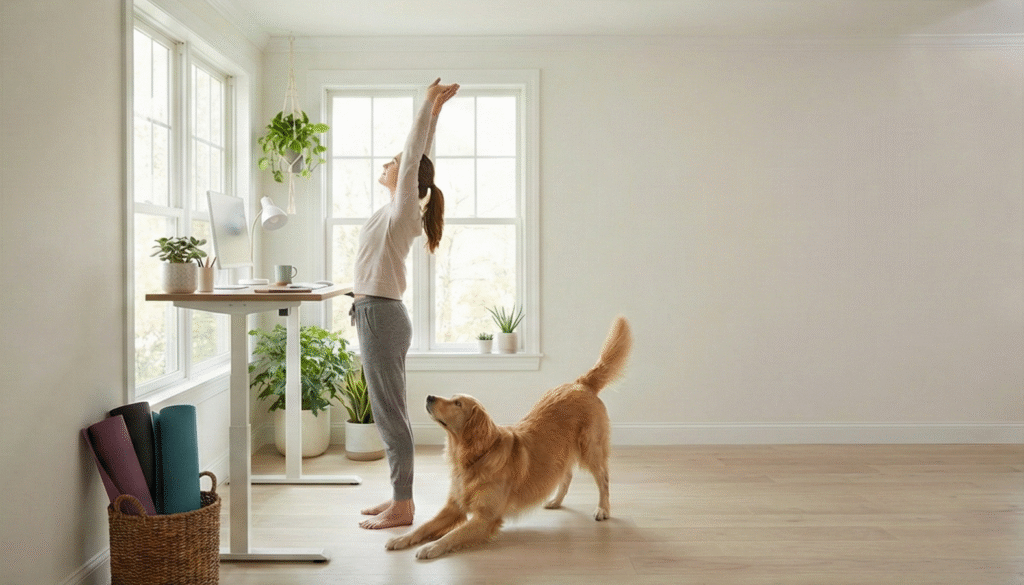
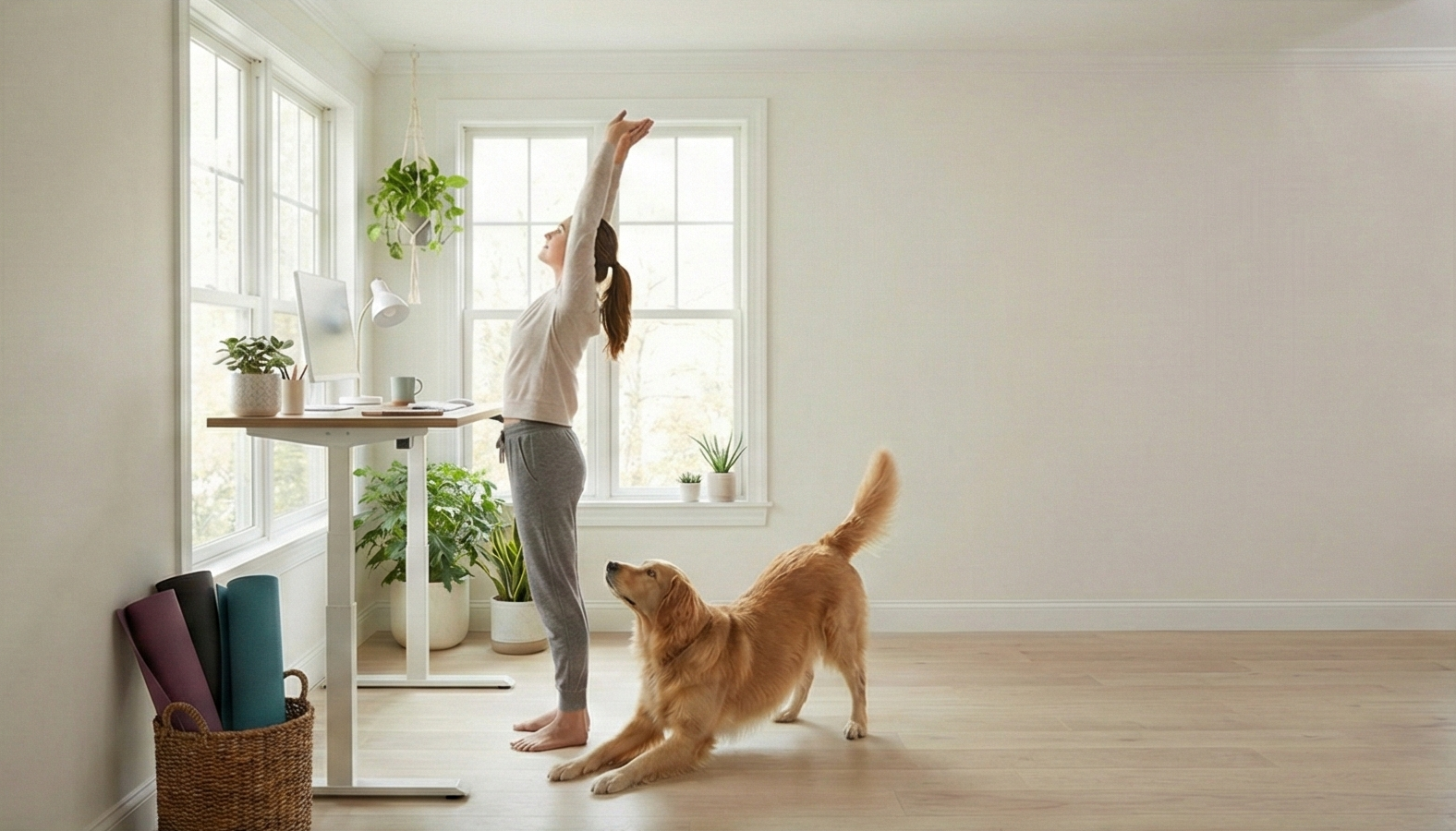
At Work and Wag Wellness, we encourage "micro-breaks." These are small moments throughout the day to reset your posture. The best part? Your pet is probably already a master of stretching. Watch them do a "downward dog" every time they wake up. We should follow their lead.
Routine at a Glance
- Neck & Shoulders: 4 moves to fix "Tech Neck."
- Spine & Hips: 3 moves to undo sitting damage.
- Wrists: 3 moves to prevent Carpal Tunnel.
- Time Needed: 5 minutes total.
Part 1: The "Tech Neck" Rescue (Neck & Shoulders)
Staring at a monitor causes our heads to drift forward. This puts immense strain on the cervical spine. Let's fix that alignment.
1. The Chin Tuck
Sit up straight. Gently pull your chin back as if you are making a "double chin." Imagine a string pulling the crown of your head upward. Hold for 5 seconds. Repeat 10 times. This strengthens the deep neck flexors.
2. Ear-to-Shoulder Release
Drop your right ear toward your right shoulder. Do not lift your shoulder to meet your ear. Keep your left shoulder pressed down. Use your right hand to gently apply pressure for a deeper stretch. Hold for 15 seconds. Switch sides.
3. The "I Don't Know" (Shoulder Shrugs)
Inhale and lift your shoulders all the way up to your ears. Squeeze hard. Exhale and drop them down dramatically. Repeat this 5 times to release built-up tension in the trapezius muscles.
4. Seated Chest Opener
Clasp your hands behind your back near your lower spine. Straighten your arms and lift them gently while puffing your chest out. This counteracts the "hunched forward" typing posture.
Part 2: Spine & Back Mobility
Your spine gets compressed when you sit for hours. These moves help get the fluid moving again.
5. Seated Cat-Cow
Place your hands on your knees. Exhale and round your spine, tucking your chin to your chest (Cat). Inhale and arch your back, looking up at the ceiling (Cow). Move with your breath for 30 seconds.
6. The Seated Spinal Twist
Plant your feet flat on the floor. Place your right hand on the back of your chair and your left hand on your right thigh. Exhale and gently twist your torso to the right. Look over your right shoulder. Hold for 10 seconds. Switch sides.
7. The Figure Four (Hip Opener)
While seated, cross your right ankle over your left knee. Keep your foot flexed to protect the knee. Gently lean forward with a straight back until you feel a stretch in your right hip. This is vital for preventing lower back pain.
Part 3: Wrist Relief for Heavy Typers
Carpal tunnel is a real risk for graphic designers and writers. Keep your wrists fluid with these drills.
8. The Prayer Stretch
Place your palms together in a "prayer" position in front of your chest. Slowly lower your hands toward your waist while keeping palms pressed together. Stop when you feel a nice stretch in your forearms.
9. The "Stop" Sign (Wrist Extension)
Extend your arm in front of you with your palm facing forward like a stop sign. Use your other hand to gently pull your fingers back toward you. This stretches the underside of the forearm.
10. The Reverse "Stop" (Wrist Flexion)
Extend your arm again, but this time point your fingers down toward the floor with your palm facing you. Gently press on the back of your hand. This stretches the top of the forearm and wrist.
Recommended Tools for Your "Wellness Corner"
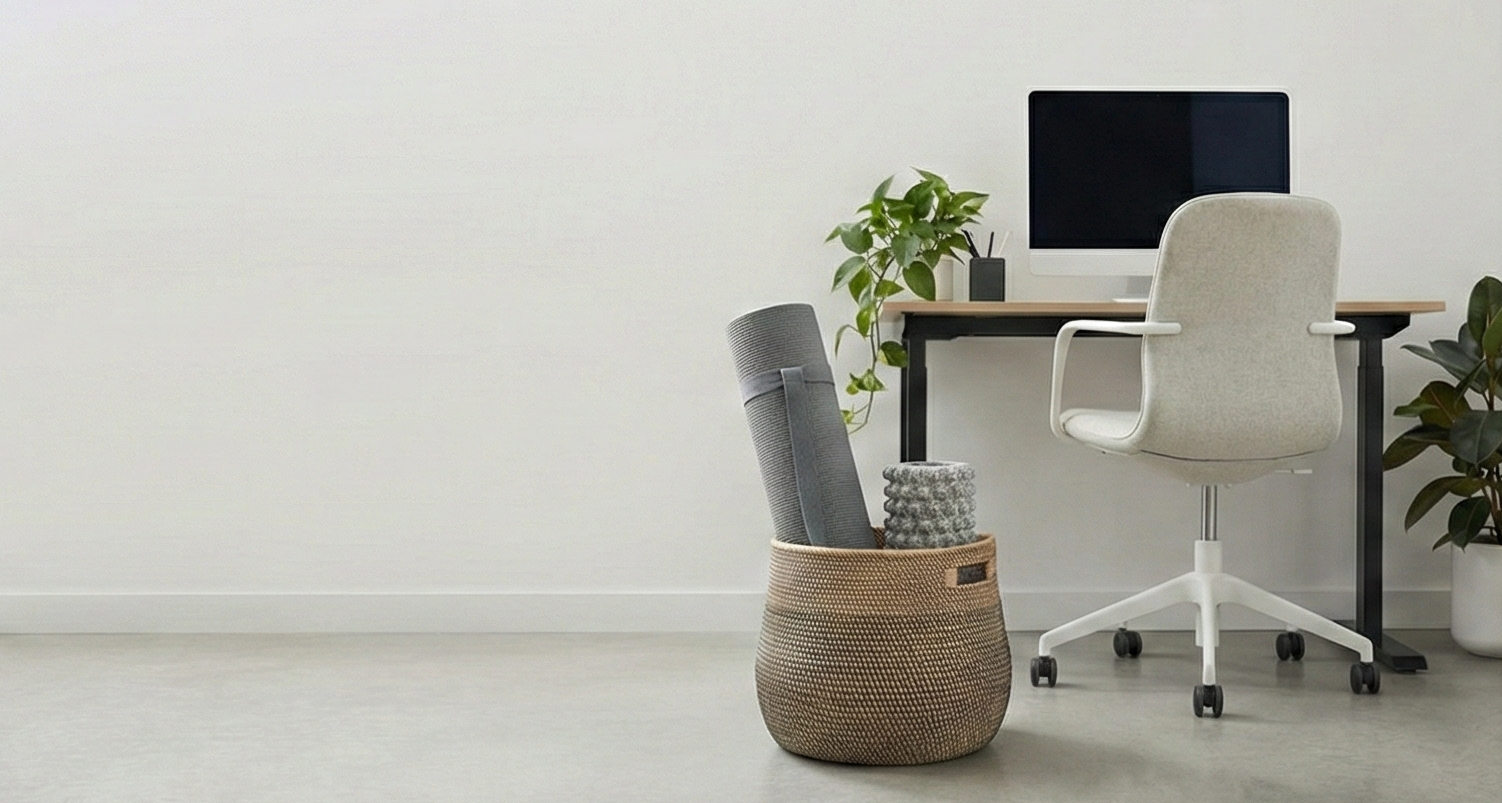
You can do all of these with just a chair, but having a few tools nearby encourages you to move more.
- Foam Roller: Great for rolling out a stiff back at the end of the day.
- Yoga Mat: Keep one rolled up near your desk. If it is visible, you are more likely to use it during a break.
- Massage Ball: Keep a lacrosse ball or dedicated massage ball under your desk to roll out the arches of your feet while you work.
Frequently Asked Questions (FAQ)
How often should I stretch during the workday?
Ergonomists recommend the "20-20-20" rule for eyes, but for the body, try to stand up or change positions at least once every hour. Even 60 seconds of movement helps.
Is it better to sit or stand while working?
The best posture is "the next one." Alternating between sitting and standing is better than doing either one for 8 hours straight. If you have a standing desk, try to stand for 15 minutes of every hour.
Final Thoughts
You don't need a gym membership to stay mobile. You just need consistency. Try to set a timer for every hour. When it goes off, pick two stretches from this list. A pain-free body allows you to work better and play harder with your pets after 5 PM.
What is your favorite way to shake off the workday? Share your routine with us!
